

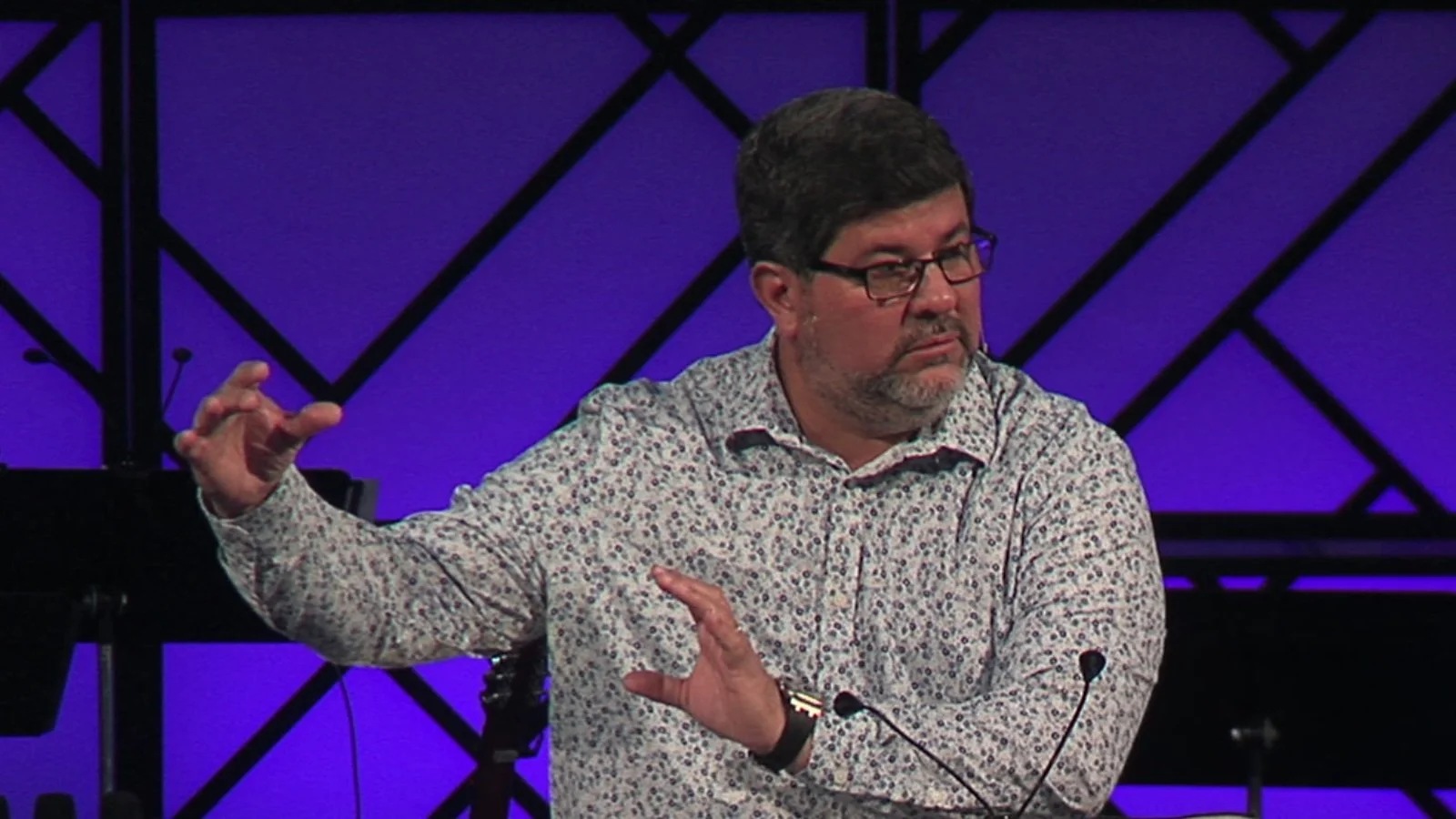
"Learning From Jesus: Morality: How Shall We Live?” | Rev. Roberto Chaple
This Sunday, New Hope continued Learning from Jesus: The Sermon on the Mount with week three. Pastor Roberto Chaple brought the message from Matthew 5:38-48 — the section where Jesus takes four familiar rules and pushes each one somewhere uncomfortable.
The first two weeks answered questions about the world and about us. What kind of world does Jesus describe? Who are we in it? Week three asks the question we tend to duck: how shall we live?
A Title Most of Us Would Rather Skip
Morality is a hard word to sit under. We are glad to bring God our requests and tell him what we need. We are much less glad to have anyone — God included — tell us how to run our lives.
And when the word does come up, most of us shrink it down to a single category. Morality gets treated as a conversation about sex and very little else. Pastor Roberto's point is that Jesus goes considerably wider than that, into the areas the religious teachers of his day skipped right past. Ours skip them too.
Roberto framed the passage with two pictures. Jesus works like a good eye doctor, examining what sits behind the way we see life — eye for an eye. And like a good dentist, he drills down to the root of what is actually causing the pain — tooth for a tooth.
The Rule Jesus Starts With
"Eye for eye, and tooth for tooth."
That line lands on modern ears as savagery, but it began as a limit. Lex talionis — the law of proportional justice — shows up in Exodus 21, Leviticus 24, and Deuteronomy 19, and it predates Israel: the Babylonian Code of Hammurabi carried the same principle around 1750 BC. Its whole job was to cap the penalty at the size of the injury, so that a slap could not escalate into a feud and a feud could not escalate into a war. Jewish law generally applied it as financial compensation rather than literal injury.
So the ancient rule was damage control. Which, if we are honest, is roughly what human justice still is.
Jesus takes his hearers past that ceiling entirely — out of the proportionality of human justice and into what Roberto called the irrationality of God's grace.
God's grace goes beyond proportional justice; it shows the pathway to overcome evil with good.
Payback keeps the score; grace settles it for good.
Turn the Other Cheek
"If anyone slaps you on the right cheek, turn to them the other cheek also."
Read it as advice about pain tolerance and it sounds like a recipe for being a doormat. Read it the way the first hearers did and something else opens up.
A slap in that culture was a public insult before it was an injury. And a strike to the right cheek, delivered by a right-handed person, has to be a backhand — which Jewish law treated as the especially degrading version. The message it carried was: you are beneath me, and I have the power to humiliate you.
Turning the other cheek refuses that message. It hands the shame back.
People may mistreat you, but don't let them define you.
People may try to diminish you, but don't let them take away your God-given dignity.
Hand Over the Coat
"And if anyone wants to sue you and take your shirt, hand over your coat as well."
Picture who this is actually about: a debtor so poor that the creditor has come for the clothes on his back. Jesus tells him to give up the outer garment too — which, in that setting, creates a scene nobody watching can look away from, and puts the creditor's behavior on public display.
The response costs the poor man something. It also refuses to answer greed with greed.
Expose evil without becoming just another evildoer.
It takes radical generosity to expose radical greed.
Go the Second Mile
"If anyone forces you to go one mile, go with them two miles."
The Greek verb behind "forces" — angareuō — is the language of compulsory service. A Roman soldier could order a local civilian to carry his equipment or run his message, and there was no appeal. It is the same verb used when soldiers pulled Simon of Cyrene out of the crowd to carry Jesus's cross.
Jesus's instruction, in effect: when the forced mile is done, keep walking.
Roberto drew out why that matters. Through the first mile the soldier holds the power. The moment the second mile begins voluntarily, the person carrying the load is the one deciding.
Answer coercion with grace and watch the oppressor lose the race.
Don't underestimate the power of the second mile.
Love Your Enemies — and the Word "Perfect"
The section closes at the hardest place: love your enemies and pray for those who persecute you… be perfect, therefore, as your heavenly Father is perfect.
"Perfect" is where most of us check out, because we hear flawless. The Greek word is τέλειος (teleios), and it means complete, whole, mature, fully developed. Something is teleios when it has become what it was made to be.
That changes the ask. If God is our Father, then becoming like him is not an impossible performance standard — it is the family resemblance we were always intended to grow into.
And Jesus points at what the Father actually does: he prays for those who persecute him, he sends sunlight on the evil and the good, he sends rain on the righteous and the unrighteous. Measured against that, loving only the people who already love us is love that has not finished growing.
If God is "our Father", then we are intended to become like Him.
Human perfection is the life-long process of allowing God's love to reach every part of our hearts and every person around us… even our in-laws.
Love your neighbor, love your foe… and love the one who takes your parking spot every Sunday.
Why Any of This Is in the Bible
Roberto closed the message where the whole series keeps landing:
The purpose of biblical morality is not to judge us, but to challenge us to be more like Jesus.
Your Next Step — The Second-Mile Challenge
Don't just take notes. Take a walk.
Pick one hard-to-love person. Every day this week, take one grace-step further than the situation requires, and pray for them by name. The sermon notes handout includes a seven-day grace tracker — one box a day, checked when you've prayed for your person.
Going further:
Who is the hardest person for you to love right now?
What would "mile two" look like for you this week?
Share that name with someone who will pray alongside you.
New Hope shared Communion together on Sunday, and Roberto tied the two things together: come to the table carrying that name. Grace was settled here first. Receive it, then go and give it away.
Want to go deeper? Grab your Bible and read the full Sermon on the Mount in Matthew 5–7. We'll keep unpacking it together — Sundays at 9:30 AM.
Listen to and subscribe to the audio-only podcast with your favorite podcasting app below.
Your giving is an act of worship. Your giving supports the mission and ministry of New Hope. We are changing lives, renewing the church, and transforming communities, here and abroad.
More Sermons in this Series
Other Sermons from Pastor Vicki
Vicki Harrison closes Learning from Jesus with the end of the Sermon on the Mount — false prophets known by their fruit, the warning that words alone are not enough, and two houses built by the same builder on different ground.