

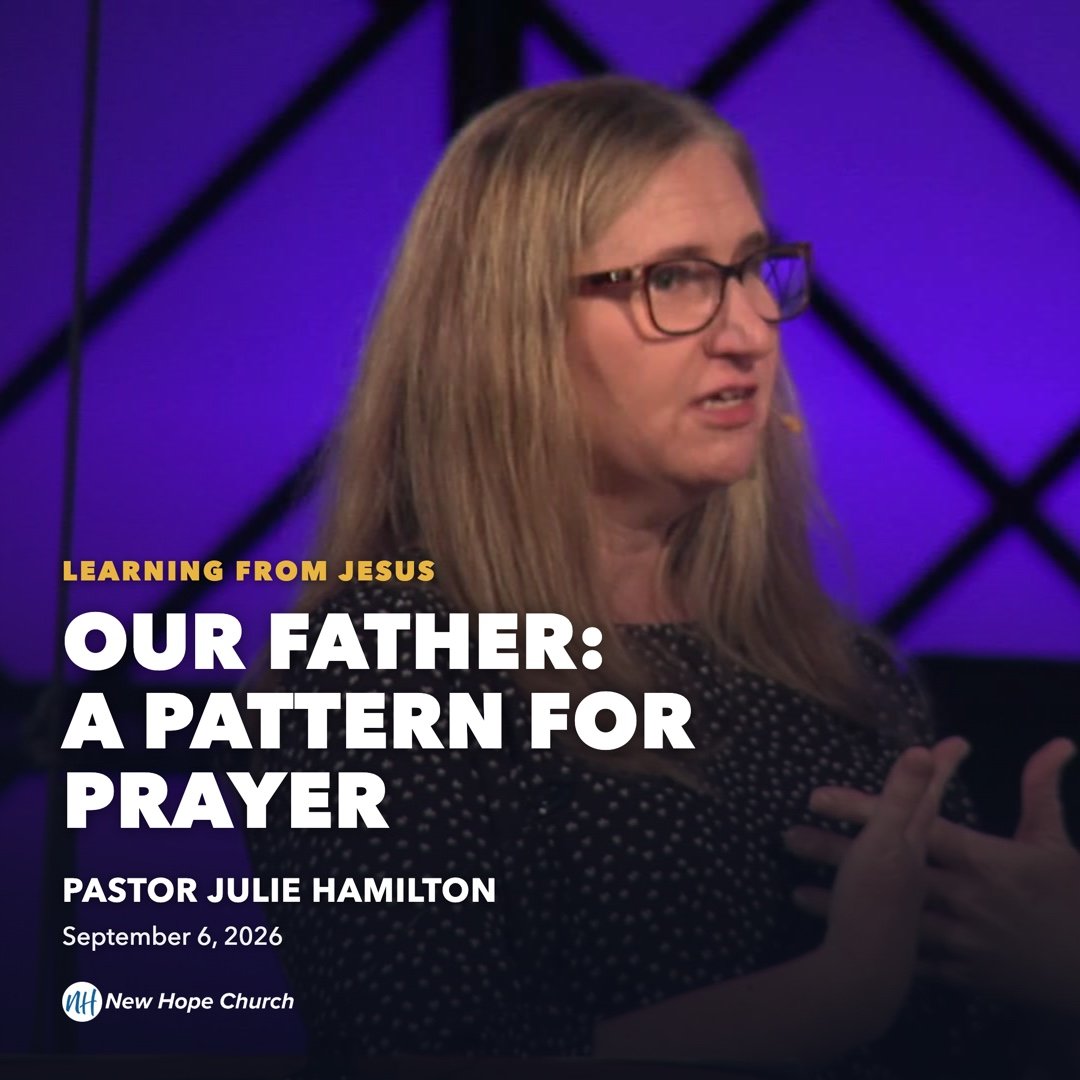
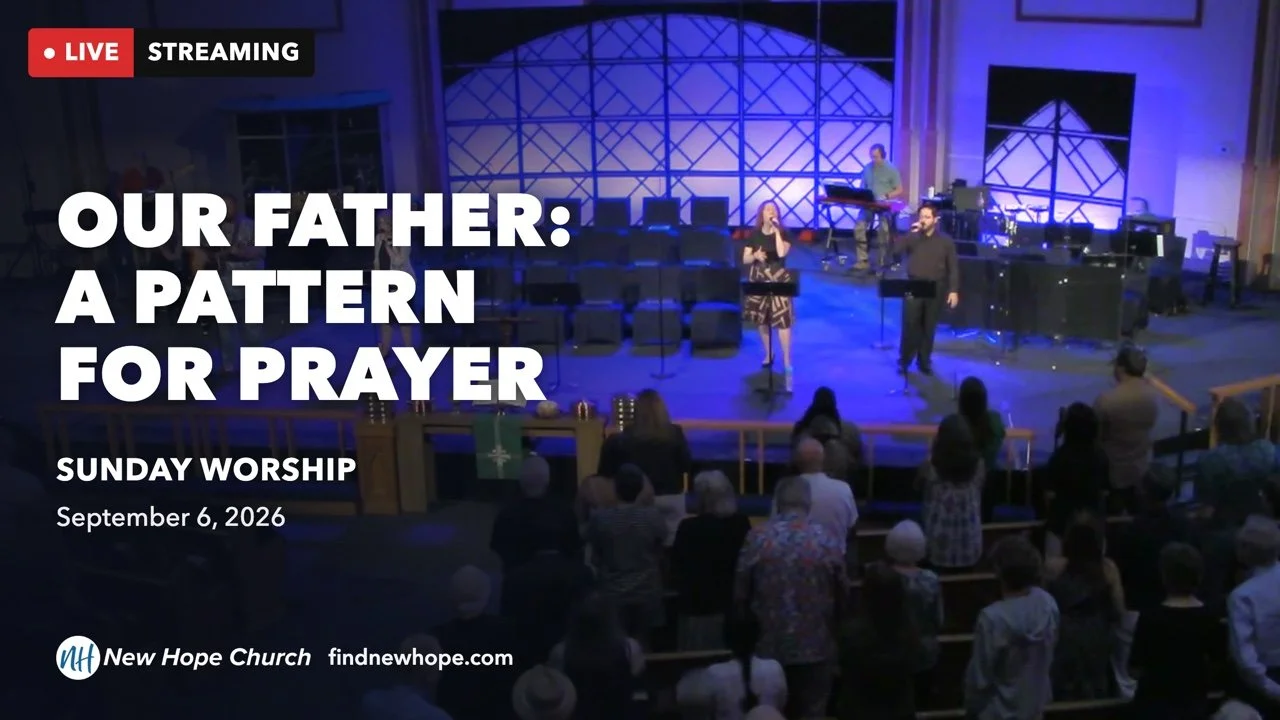
This Sunday, New Hope continued Learning from Jesus: The Sermon on the Mount with Julie Hamilton bringing the message from Matthew 6:5-13.
The series has been working through a set of questions. The early weeks asked who we are — our identity according to God, and how we are meant to influence the world rather than let it influence us. Last week asked how we should live. This week asks about connection: how do we actually pray?
The One Thing They Asked To Be Taught
Julie opened with an observation that is easy to skim past in the Gospels.
Jesus taught the disciples on hundreds of subjects — faith, money, forgiveness, the end times, leadership. Almost every one of those teachings started with Jesus, or came out of a situation the disciples were stuck in. Why couldn't we drive out that demon? Who is the greatest in the kingdom?
Prayer is the exception. Prayer is the only subject where the disciples came to him and asked directly: "Lord, teach us to pray."
And they were not asking from a distance. The New Testament records Jesus praying thirty-four times. They watched him do it. They prayed with him. They saw him withdraw to be alone with the Father. After all of that, they still asked to be taught.
Julie's read on that: if they needed the lesson, his answer is worth our attention.
What The Word Actually Means
Before opening the passage, Julie stopped to define the term.
The most common New Testament Greek word for prayer is proseuché (προσευχή) — pro-su-kay. It comes apart into two pieces:
Pros — a preposition meaning toward, facing, or drawing close
Euché — a vow, a wish, something spoken aloud
Put back together:
Prayer is drawing close to God to present our requests, worship, and surrender.
Worth noticing what is load-bearing there. The drawing close comes first. The requests are part of it, not the point of it.
The Quilt
Then Julie asked the congregation a question, and gave them a minute to actually sit with it: when was the first time you prayed?
Never? Last week? Ten years ago? Fifty? Maybe it was the night a child got seriously ill. Maybe it was the sinner's prayer. Maybe it was a small voice at a dinner table.
Her own answer came with her to the platform. She held up a quilt — one that was made for her, one she loved because it was soft and fit just right. She outgrew it and started using it to play with her dolls. It is worn and frayed now and lives in a closet, and it still carries a place in her memory.
What burned it into her memory was the routine around it. There was part of a prayer stitched on it, and she recited it every night as she climbed underneath:
Now I lay me down to sleep, I pray the Lord my soul to keep, and if I die before I wake, I pray the Lord my soul to take.
Julie's line about it:
Before I even knew my soul and body could be parted, my mouth prayed words with eternal implication.
Which is her way into the thing she wanted the room to hear. We all carry different memories of prayer, and some of us carry none. Prayer can be taught, witnessed and practiced long before it is fully understood.
That is exactly where the disciples were standing when they asked.
Matthew 6:5-8 — Clearing The Ground
Before Jesus gives the model, he removes two things standing in the way. Julie walked the passage in order.
Verse 5 — prayer as performance. "When you pray, do not be like the hypocrites, for they love to pray standing in the synagogues and on the street corners to be seen by others."
The problem is not public prayer. The problem is the motive. These prayers were timed and positioned for maximum visibility, and Jesus is blunt about what that earns: "they have received their reward in full." The applause was the payment, because the applause was the goal.
Prayer can become theater. It is possible to speak words to God while performing for people.
Verse 6 — prayer as relationship. "But when you pray, go into your room, close the door and pray to your Father, who is unseen."
Not a rule against ever praying out loud in company — a correction to the heart. Prayer's true audience is God. And the phrase your Father, who is unseen carries the intimacy the whole passage keeps returning to. Not a distant deity to be impressed. A Father to talk to.
Verses 7-8 — prayer as magic formula. "Do not keep on babbling like pagans, for they think they will be heard because of their many words."
This one is aimed at ritual practice — heaping up words, repeating incantations, as though God has to be worn down or brought up to speed. Then comes the line Julie flagged as the theological hinge of the whole section:
"Your Father knows what you need before you ask him."
In Methodist language, that is prevenient grace — God at work ahead of us, before we ask, before we know to ask. And it reframes the entire question of why we pray at all. If God already knows, prayer is not information transfer. It is relationship, trust, and alignment.
The Turn
"This, then, is how you should pray…"
Jesus has corrected the motive and the manner. Only now does he give the model — and Julie was careful about what kind of thing it is. Not a formula to recite mindlessly, which is precisely what verses 7-8 just ruled out. A pattern for a heart pointed the right way.
The Pattern, In Four Movements
I. The Address — "Our Father in heaven"
Three things happen in four words. Father is intimacy, relationship rather than mere reverence. Our is community — this is a shared prayer, not a private one, spoken with the whole family of God. In heaven is transcendence — near to us, and still holy and sovereign.
Prayer starts with who God is, not with what we want.
II. The Priorities — three "Your" petitions
Hallowed be your name — his reputation and holiness come first
Your kingdom come — longing for God's will rather than our agenda
Your will be done, on earth as it is in heaven — surrender, not merely request
Right prayer aligns our hearts with God's purposes before it asks for anything. In God's name, for God's kingdom, to do God's will.
III. The Provision — three "Us" petitions
Give us this day our daily bread — dependence for physical needs, one day at a time
Forgive us our debts, as we forgive our debtors — dependence for spiritual and relational needs, with forgiveness given and forgiveness received tied together. Justifying grace.
Lead us not into temptation, but deliver us from evil — dependence for protection and guidance. Sanctifying grace.
IV. The Praise — the doxology
"For yours is the kingdom, and the power, and the glory forever."
The prayer ends where it started, pointing back at God. Worship frames both ends.
Back To The Quilt
Julie closed where she began.
Those recited words planted something that took years to grow. As a child, the routine gave her comfort — less from understanding the words than from some sense of who she was talking to. As an adult, the same words give her a peace she says she cannot explain, because now she understands, and now she knows the God she is speaking to.
Her point is that the Lord's Prayer can work on us the same way. It gives us a routine of sorts, a pattern, in which the words gain weight as we walk closer to Jesus. When we posture our hearts toward connection, something that could stay a thing we merely do becomes a reflection of an actual relationship.
The Lord's Prayer is a template for a whole life of prayer: worship, surrender, dependence, forgiveness, protection — connection.
And it is not the only way to pray. It is a model for finding the path.
Your Next Step
Pray it slowly this week. Phrase by phrase, not start to finish. Let each line open into a fuller prayer of your own.
Then find your quilt. Where, when and how did you first experience prayer? And what would your experience of prayer look like now without it?
Going further:
Which of the four movements — worship, surrender, dependence, forgiveness — is thinnest in your own praying?
Whose forgiveness is tied up in the line about debts?
Who taught you to pray, and have you ever told them what it did?
Rather than closing with a prayer over the room, New Hope stood and prayed the Lord's Prayer together through song, led by the worship team — the whole family praying the same words to the same Father.
Want to go deeper? Grab your Bible and read the full Sermon on the Mount in Matthew 5-7. We'll keep unpacking it together — Sundays at 9:30 AM.
Listen to and subscribe to the audio-only podcast with your favorite podcasting app below.
Your giving is an act of worship. Your giving supports the mission and ministry of New Hope. We are changing lives, renewing the church, and transforming communities, here and abroad.
More Sermons in this Series
Other Sermons from Pastor Vicki
Vicki Harrison closes Learning from Jesus with the end of the Sermon on the Mount — false prophets known by their fruit, the warning that words alone are not enough, and two houses built by the same builder on different ground.