

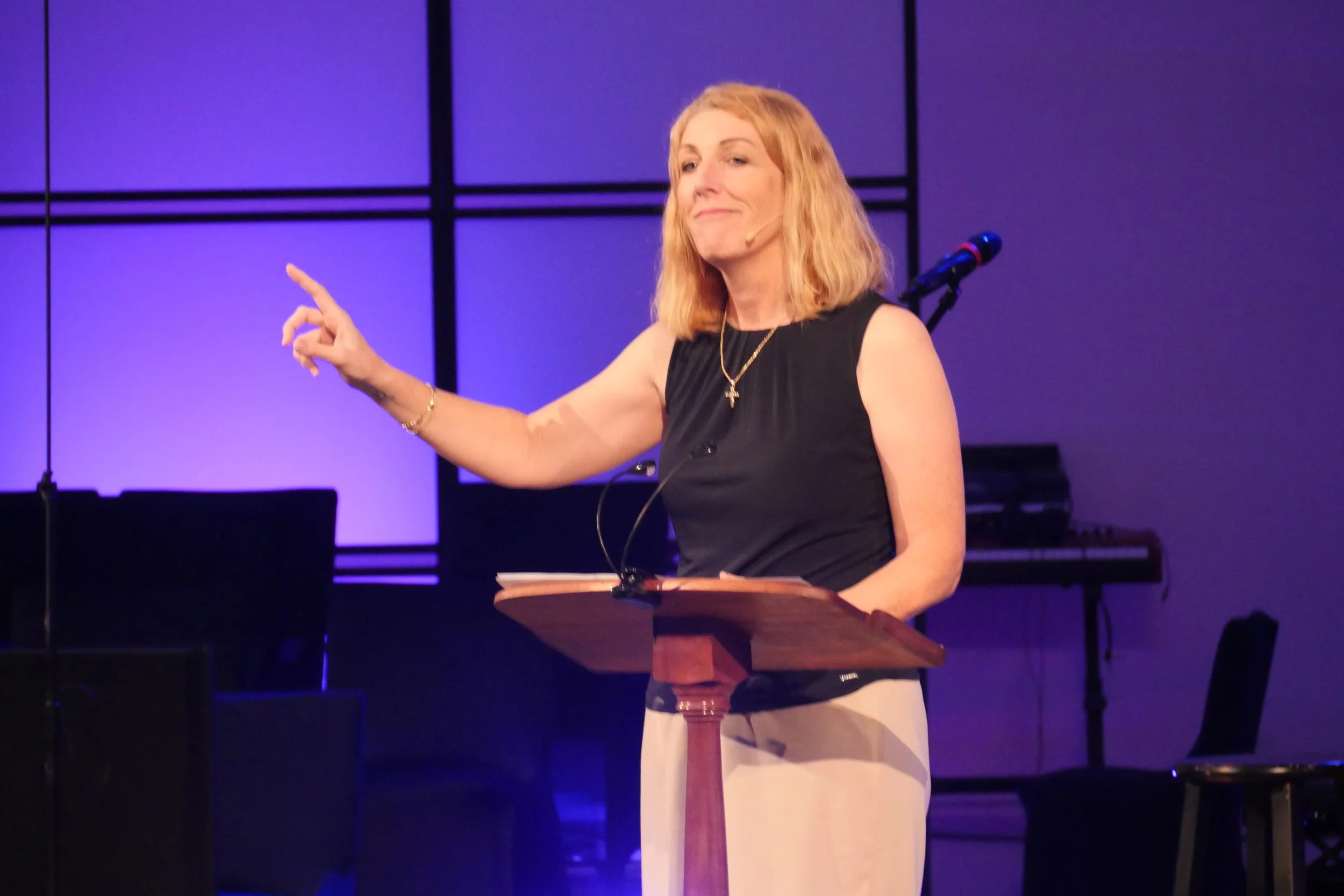
At New Hope this Sunday, June 7, we began our new teaching series — "Let the Lion Roar," a journey through the book of Amos — with a message titled "In Pursuit." Pastor Vicki Harrison opened the series in Amos 1–2, and it set the tone for the weeks ahead.
She started with a picture. On a 2024 trip to Mozambique to visit an orphan-empowerment ministry, she traveled to Gorongosa National Park and saw lions up close. In the heat of the day, lions can look almost cuddly — right up until you hear them roar. A lion's roar can reach 114 decibels, and it jolts you back to reality: this is an apex predator, fierce, at the very top of the food chain.
That's the image Amos opens with — God roaring like a lion.
"The Lord roars from Zion and thunders from Jerusalem; the pastures of the shepherds dry up, and the top of Carmel withers." (Amos 1:2)
If a lion's roar is that loud, how much louder is the roar of God? When God roars, people should pay attention. But why is God roaring?
A Comfortable People and an Unpopular Prophet
Amos isn't a book we talk about often, but there's a lot packed into it. Amos was one of the twelve minor prophets — "minor" only because the book is short, not because it matters less. He was a shepherd and a fig farmer, a humble man God called to speak to the Northern Kingdom in the eighth century B.C.
It was a season of relative peace and prosperity. The economy was strong, the land was producing, there was no war, and the people assumed all of it meant they had God's blessing. The upper crust were living the good life. But beneath the comfort, two problems had taken root — idolatry and injustice — and on faith alone, Amos headed north to Bethel to announce God's word to a people who didn't want to hear it.
What God Is Roaring About
The roar isn't delight. It's anger and judgment. Amos pronounces judgment first on the surrounding nations — Damascus, Gaza, Tyre, Edom — for their violence and cruelty. The crowd would have loved that part: yes, God is going to deal with our enemies. Then Amos turns to Judah. Then, finally, to Israel itself:
"For three sins of Israel, even for four, I will not relent." (Amos 2:6)
The point is that God sees everything, counts everything, and judges everything — and His patience has a breaking point. What He names in Israel is the crushing of the vulnerable:
"They sell the innocent for silver, and the needy for a pair of sandals… They trample on the heads of the poor as on the dust of the ground and deny justice to the oppressed." (Amos 2:6–7)
There was gross inequality. People so poor they went into debt for something as small as a pair of sandals. Families selling themselves into slavery to survive. Powerful landowners using the courts to twist justice. The poor were being treated like dirt — while the comfortable looked away.
Worship Without Justice
Here's the part that stings: Israel was deeply religious and deeply unjust at the same time. Worship was popular and crowded. Festivals were observed with lavish arrangements — big offerings, well-tuned orchestras, lovely choirs, beautiful liturgies. No expense spared, no detail overlooked.
And God was disgusted by it. Not because the services were sloppy, but because they were hollow — He saw the apathy, He saw their hearts, He saw a people who were all about appearances but weren't living their faith.
Does God Care About Injustice?
That's the question this whole series is wrestling with: does God care about injustice?
When you look at the world — violence against the innocent, human trafficking, exploitation, oppression, desperate poverty in so many places — it's an honest question to ask: God, don't you care? Why are you silent?
This Sunday's answer is clear: yes — our God cares deeply. God is not silent; He is in pursuit. He speaks out passionately against injustice and sin, and He will have the last word. If you are the victim of injustice or inhumanity, God is on your side. He is roaring.
God hates evil — though He doesn't always handle it the way we would. His answer to evil was sending Jesus to the cross: the One who truly understands suffering, and the only One through whom true and complete healing comes. In the end, Jesus will return, evil will be defeated, and every injustice will be set right.
In the Meantime, We Act
But here's the thing — in the meantime, God expects His people to stand up against injustice. We can't be apathetic. We can't worship on Sunday and tolerate injustice on Monday.
Pastor Vicki recalled hearing Gary Haugen of International Justice Mission, an organization that works to rescue people from violence and trafficking, put it this way: "What's God's plan for justice in this world? Just us. We are plan A, and there is no plan B." And he added, "We can't let fear get in the way of what God has called His people to do."
So we're going to wrestle with Amos together, New Hope. It won't be easy. And the first step is prayer — asking Jesus for help to know what to do and how He wants us to respond.
Join Us
"Let the Lion Roar" continues each Sunday through July 5. Catch this message or any in the series at findnewhope.com/message-archive — and come this Sunday ready to listen for the voice of the One who roars, and who is good.
Listen to and subscribe to the audio-only podcast with your favorite podcasting app below.
Your giving is an act of worship. Your giving supports the mission and ministry of New Hope. We are changing lives, renewing the church, and transforming communities, here and abroad.
More Sermons in this Series
Other Sermons from Pastor Vicki
Amos 9 brings the Let the Lion Roar series to a close with a hard word and a hopeful one: judgment is real, but God is not finished. Next Sunday, Pastor Vicki Harrison opens the final chapter of Amos with a message about rebuilding, restoration, and the kind of renewal that reaches all the way into the future.