

The staircase, one step from the top
Four weeks ago this series asked what your next step is, and promised God only shows you one stair at a time. Julie picks the thread back up where it's been all along:
"Our humanness says we want to see the whole staircase, but God usually shows us one step at a time, and he asks us to trust him with it. Each step we've talked about has been a step deeper into relationship."
Prayer was the most personal step — just us and God. Worship widened the circle: Hebrews reminding us we draw near to God together. Service turned us outward, a towel in hand instead of a title. Generosity brought it full circle — giving because God gave first.
"With God, with each other, with the people we serve, with the people we haven't met yet, every step has been about relationship. And that's where we land this week."
Small community, and why it isn't optional
Today's question: What's my next step, God, in small community? New Hope runs on more kinds of small community than most people realize — Sunday School classes, Bible studies, Wesleyan band groups, Meet and Walk, moms' groups, the choir, bridge groups, sewing groups, recovery groups like AA and NA, MOW, and more. Julie's point isn't that one kind is better than another — it's that every one of them exists for a reason, and the reasons are different:
"Any time a group of people meet regularly, we call that a form of small community. All of these groups are good... but they serve different purposes. A young mom's play group is drastically different from a Bible study on the book of Romans."
The questions she leaves hanging: Do you have small community? What are you actually diving into when you show up? And — the series' real refrain — what might your next step be?
"Habits can form easily, relationships build and we find purpose... then before you know it we are doing the same things we have always done even though our lives, our needs, our seasons have changed."
The text: a persecuted church that stayed together
The anchor is Hebrews 10:24-25:
"And let us consider how we may spur one another on toward love and good deeds, not giving up meeting together, as some are in the habit of doing, but encouraging one another — and all the more as you see the Day approaching."
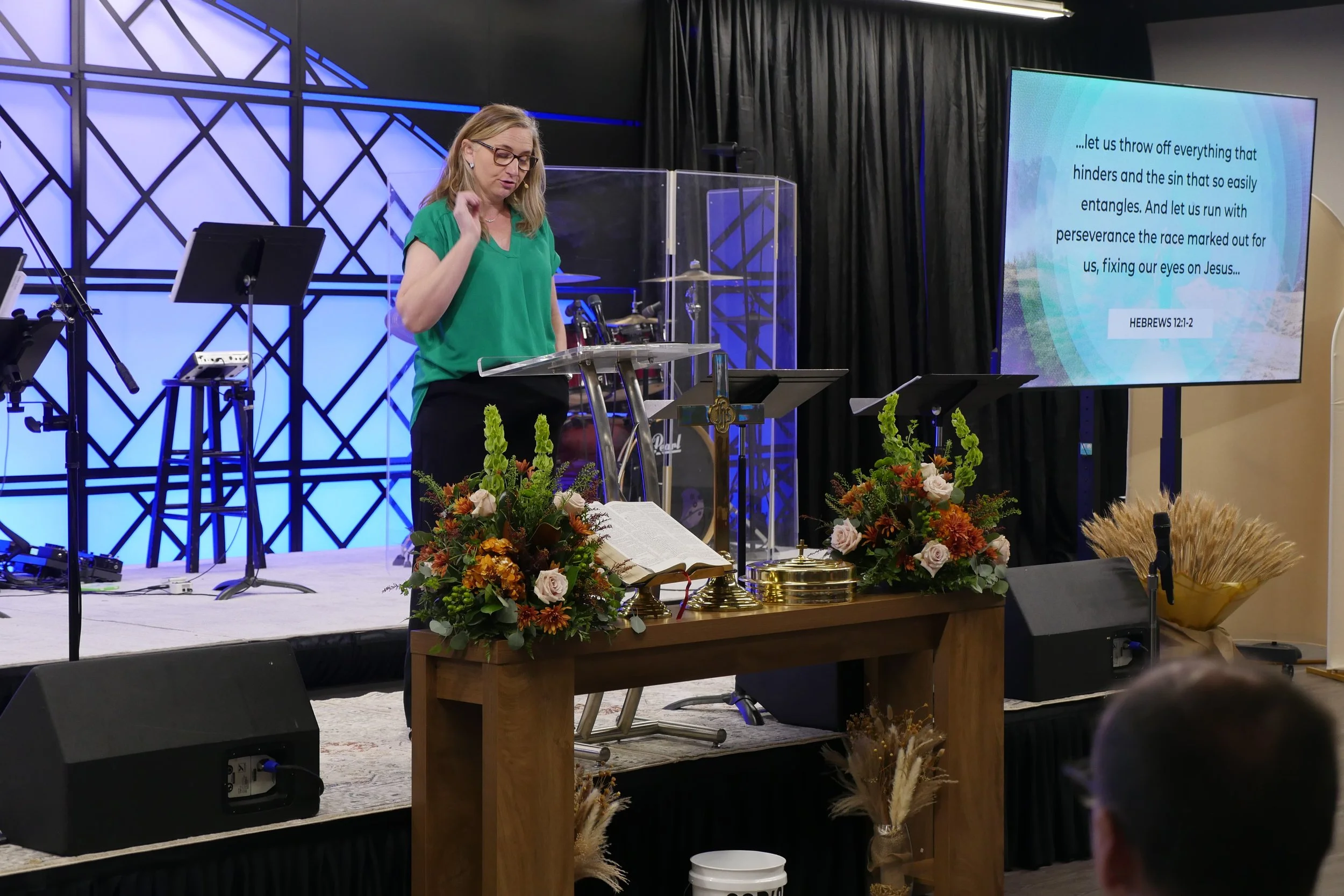
Julie places it where it was written: to Jewish Christians under real persecution, close to walking away from their faith entirely. The author's posture, as she describes it, is less preacher than coach on the sideline — don't give up, stick together, encourage one another, you can do this if you do it together. Hebrews 12:1-2 extends the same appeal:
"Let us throw off everything that hinders and the sin that so easily entangles. And let us run with perseverance the race marked out for us, fixing our eyes on Jesus."
It's a long race, not a sprint — and Julie's read is blunt: the only way to finish it is alongside other Christians. The word encourage, she points out, shows up in some form twenty-five times in Hebrews — sometimes encourage, sometimes plead, sometimes urge. "You need that encouragement. You need that pleading. So do I."
The illustration
"Emma and Nina, donut run. Small community is creating those family bonds God desires for his people. That's why we gather together. We gather together because left to ourselves we will stop running. We will wander off on our own and sit down. We won't keep our eyes fixed on Jesus — or the finish line. We need each other."
Acts 2: what it actually looked like
From there to Acts 2:42-47, which Julie calls the clearest picture of small community in Scripture:
"They devoted themselves to the apostles' teaching and to fellowship, to the breaking of bread and to prayer... All the believers were together and had everything in common... Every day they continued to meet together in the temple courts. They broke bread in their homes and ate together with glad and sincere hearts."
Teaching, fellowship, shared meals, prayer — in homes and in public. The early church's letters, she notes, kept circling back to the same charge: hold each other up, make sure your brother and sister stays the course. And that charge pointed toward something bigger — holiness. As 1 Peter frames it: being children of God means looking different from the culture around you, not blending into it.
Wesley: holiness isn't a solo project
The hinge of the whole message is John Wesley's line — Methodism's founder, and the reason New Hope exists as a Wesleyan church at all:
"There is no holiness but social holiness."
Julie's gloss: Wesley meant Christians getting to know each other well enough — no masks, no pretending, no withholding — that they could hold one another accountable, show love, and push each other toward growth. In his view, it wasn't the best way to grow in holiness. It was the only way.
"Somewhere along the way, the western church has believed the lie that the goal of the Christian life is to accept Jesus so we go to heaven when we die. And that, my friends, is a lie. The goal of the Christian life is to become more like Jesus right now and bring more of heaven to earth."
Three purposes, one framework
Not every group does the same job, and Julie gives New Hope's small communities a three-part shape — the same one on the "Small Community at New Hope Church" handout:
Discipleship = Maturity — How are we growing?
Fellowship = Belonging — How are you doing?
Service = Mission — Who are we helping?
"Healthy small community at New Hope Church is characterized by discipleship for maturity, fellowship for belonging, and service for mission. Together, they're how we grow in holiness — becoming more like Jesus, side by side."
Most groups lean toward one of the three even while touching the other two — and that's by design, not a flaw. The point isn't to rank groups against each other. It's to help you see, honestly, where your own group sits, and what might be missing.
The landing
Five weeks of asking the same question, and it ends here: faith was never meant to be carried alone. If you walked into this series wondering what's next, Julie's answer for this week is the most practical one yet — find your people, or find out what you're actually looking for in the group you've already got.
"What might God be calling you to do? Have you talked to God about it?"
Listen to and subscribe to the audio-only podcast with your favorite podcasting app below.
Your giving is an act of worship. Your giving supports the mission and ministry of New Hope. We are changing lives, renewing the church, and transforming communities, here and abroad.
More Sermons in this Series
Other Sermons from Pastor Vicki
Celebration is not a reward the church earns when things go well. God built it into the calendar. Rev. Vicki Harrison reads Psalm 100, Psalm 136 and Psalm 150 with the congregation standing, and tells the story of a church that has been caring for people in Brandon for almost 150 years.