

At New Hope This Sunday
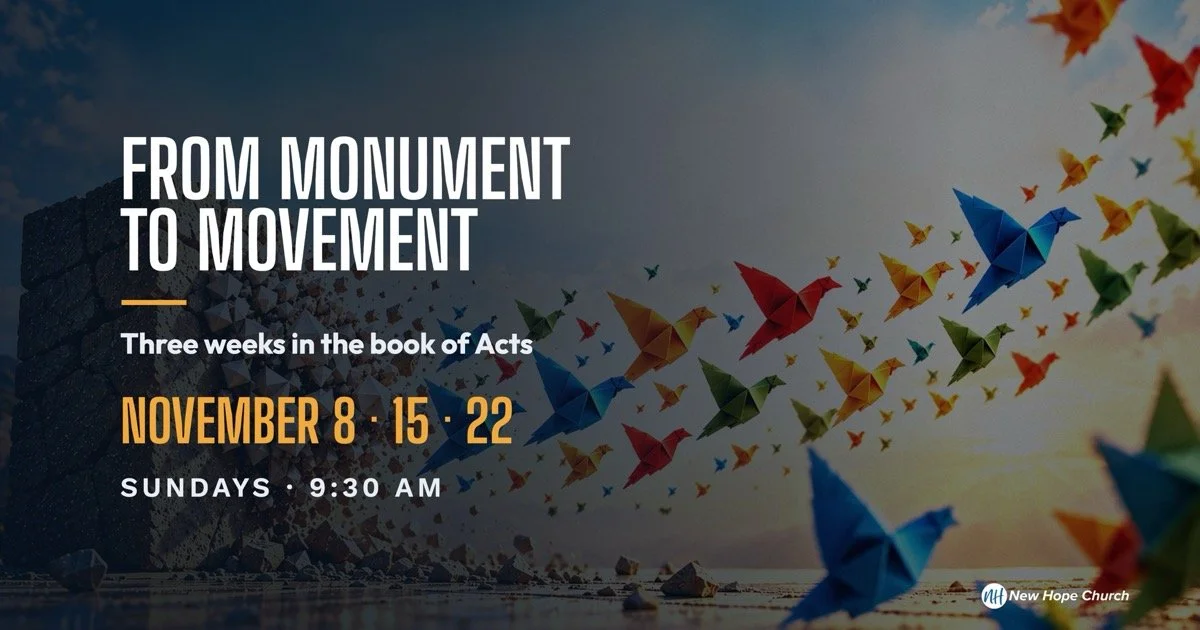
New Hope opened a new series this morning: From Monument to Movement, three Sundays in Acts on how the New Testament church made disciples, sent them out, and multiplied. Rev. Roberto Chaple preached week one, Jerusalem.
A few other things going on around the church:
Starting Point: Discover New Hope, the first of a new three-Sunday cycle, met this morning at 11:00 AM in Room NH-101. If you missed it, the series continues November 15 (Develop Faith) and November 22 (Commit to Serve) — it's the on-ramp for anyone new to New Hope, or anyone who's been here a while and never quite landed anywhere.
Women of Hope Pecan Sale pick-up, Saturday, November 14 and Monday, November 16, 8:00 AM to 5:00 PM, in the Life Center gym. Ordering has closed. Prepaid orders are reserved, and anything not prepaid is first come, first served on pick-up day.
Men of Valor Iron Morning Breakfast and the Handyman Ministry's first work day, Saturday, November 14, Social Hall. Eat, pray, work: the men gather for breakfast, then go out in teams to help with projects around the church family. (Start time to be confirmed — watch the bulletin.)
Church Conference, Sunday, November 15 at 3:00 PM, Social Hall A. This is the church's business meeting, and members and congregation are both welcome.
Next Sunday, November 15: the series continues with Antioch — how a sending church sends out its best people instead of holding on to them.
Jerusalem — Make Disciples
The Gospel, Roberto said, is the greatest message ever told — "but the worst marketing." We wrestle with it once, at the start, and then spend the rest of our lives wrestling instead with "this whole church thing": how do we get it right? His answer opened with a statistic, and a hard question about what we've let church attendance mean.
The facts, and the monument we built
Citing Barna Group's 2025 research, Roberto noted that the average attendance among self-professed Christian churched adults is 19 Sundays a year. "If you attend church 19 Sundays a year," he said, "congratulations, you're average. If you attend more than 19 Sundays a year — congratulations, you're above average." Then the turn: is church attendance the whole thing about being Christian? "Worse yet," he said, "we have convinced ourselves church attendance is the highest, if not the only, measure of our Christian commitment."
Somewhere along the way, he said, "we have turned what was meant to be a movement into a monument." He pointed to the Old Testament, where monuments God's people were told to build later became the very things that stopped them moving forward, and to Peter on the mountain of the Transfiguration, wanting to build three shelters rather than simply follow Jesus back down (Matthew 17:4). "Sometimes," Roberto said, "we take attendance as a monument."
Two lessons from the early church
"Church vitality isn't measured just by attendance, but also by its ability to reproduce and multiply disciples." Stagnant, he said, is what we are before we become irrelevant. "Attendance is necessary, but attendance is like the charging station — it is not the destination."
"Church attendance is not the goal; it's the byproduct of a vital church." The early Christians were focused on making disciples, not on building churches — and churches grew as a result. "If you make disciples, you will always get a church. But if you focus on making church, you probably rarely get disciples."
The pointed question that follows: who are we discipling right now?
This series, Roberto explained, is about three churches that were directly engaged in that work, each with a different piece of it: Jerusalem made disciples, Antioch sent them out, Ephesus multiplied them. "Three cities, three models, one movement."
An atmosphere where discipleship flourishes
Jerusalem is where the story starts. Acts 2:47 is the week's key verse: "the Lord added to their number daily those who were being saved." It caps off the account of the very first church — the believers described in Acts 2:42-47 as devoted to the apostles' teaching, to fellowship, to the breaking of bread and to prayer.
Roberto's question for New Hope: what was going on in Jerusalem that God himself kept sending people to disciple — and what changes 21 centuries later, here at New Hope, so he'll do the same? "God moves in atmospheres." He reached for the troposphere, the thin band of Earth's atmosphere where life is actually possible, as the picture: create the right environment, and God adds people — "daily, by the way." The Jerusalem atmosphere, he said, was built on prayer and worship: "not just any worship — authentic worship. It's okay to mess up the words of the song" — unashamed worship, giving people the freedom to worship God organically.
He pointed to Wednesday's Recharge small groups, most weeks taught by Pastor Vicki, as New Hope's own version of that same atmosphere — a place to ask the question you're too nervous to ask on Sunday morning.
Growth brings friction — and it brings new leaders
The model wasn't tidy. Acts 6:1 records the church's first real internal conflict: Greek-speaking believers complaining that their widows were being overlooked in the daily distribution of food, while the Aramaic-speaking widows were not. "Church complainers are as old as the church itself," Roberto said. Growth, in his framing, is like parenting — beautiful, but it always comes with challenges. He pointed, half-joking, to the sanctuary's own new carpet: "we tend to like church growth until kids happen, and they spill coffee on this floor... can we celebrate the coffee spill?" Growth, he said, is liked right up until strangers happen, until somebody takes my pew, or until my small group has to give up its room to the youth.
The church's fix became the pattern: seven men, "full of the Spirit and wisdom," were chosen to oversee the distribution — and by their Greek names, they were Hellenistic, not Hebraic, the very group that had been doing the complaining. Only seven verses separate the complaint in Acts 6:1 from the result in Acts 6:7: the word of God spread, and the number of disciples increased rapidly. "It is okay to deal with conflict, but it is not okay to dwell in conflict."
The ripple
Luke doesn't stop the story in Jerusalem. The same pattern, Roberto said, ripples outward through the book of Acts: in Judea, Galilee and Samaria, the church "enjoyed a time of peace and was strengthened... and increased in numbers" (Acts 9:31); in Caesarea, "the word of God continued to spread and flourish" (Acts 12:24); in Derbe, Lystra and Iconium, "the churches were strengthened in the faith and grew daily in numbers" (Acts 16:5). "Daily," he said, "means systematic, not sporadic, growth." Discipleship, in his telling, isn't about informing people — it's about empowering them to discover the power of God's word for themselves.
Making it personal
The message closed with a run of direct questions. Can I say I follow Jesus if I have never led a single person to follow him too? "People can question your theology, but they will never question what God has done in your life. They will never question your testimony." Is Jesus the passion you are known for? "The first step toward more," Roberto said, "is to want more" — and a question about how much New Hope is willing to sacrifice to create an atmosphere where new disciples are made here. Is discipleship, for you, a class you attend or a daily rhythm of learning, fellowship, communion and worship? In the Jerusalem model, it was a daily habit — second nature.
He closed by asking the same question twice: "When was the last time you had a conversation with someone about Jesus?"
This week's materials
Bulletin: Download Here
Sermon Notes: Download Here
Listen to and subscribe to the audio-only podcast with your favorite podcasting app below.
Your giving is an act of worship. Your giving supports the mission and ministry of New Hope. We are changing lives, renewing the church, and transforming communities, here and abroad.
More Sermons in this Series
Other Sermons from Pastor Vicki
New Hope opens a new series, From Monument to Movement, tracing three New Testament churches that stayed on mission instead of settling into monuments. Week one lands in Jerusalem, where Rev. Roberto Chaple opens Acts 2:42-47 and Acts 6:1, 7 to ask what it looks like when a church actually multiplies disciples instead of just filling seats.